Robotics – Arduino And Pi Projects – 3D Modelling – Flash Animation – Apps – IT – Plus More


A microcontroller or microcontroller unit (MCU), is an electronic control device that incorporates a microprocessor. A microprocessor is an integrated circuit that contains all the functions of a central processing unit of a computer. So a microcontroller is a small self contained computer with an embedded system on a chip (SoC), usually within a single integrated circuit (IC) containing a processor core, memory, programmable input/output attachments (the attachments are known as peripherals), programmable memory in the form of ferroelectric RAM (ferroelectric, a property of the material, it has a spontaneous electric polarization, it can be reversed with an external electric field.), NOR flash or OTP ROM (one time programmable ROM) which is often included on many chips now and a minuscule amount of user RAM.
At its most basic a microcontroller is a self contained computer with a microprocessor that contains a few additional components e.g RAM, ROM, programmable I/O ports primarily designed to control and drive other electronic equipment. Most modern consumer microcontrollers are equipped with general purpose input/output PINs (GPIO PINs), such as the Raspberry Pi and Arduino.
Microcontrollers are offten designed for embedded applications, in contrast to the microprocessors that are designed for use in personal computers (PCs) or other general purpose applications consisting of various discrete chips.


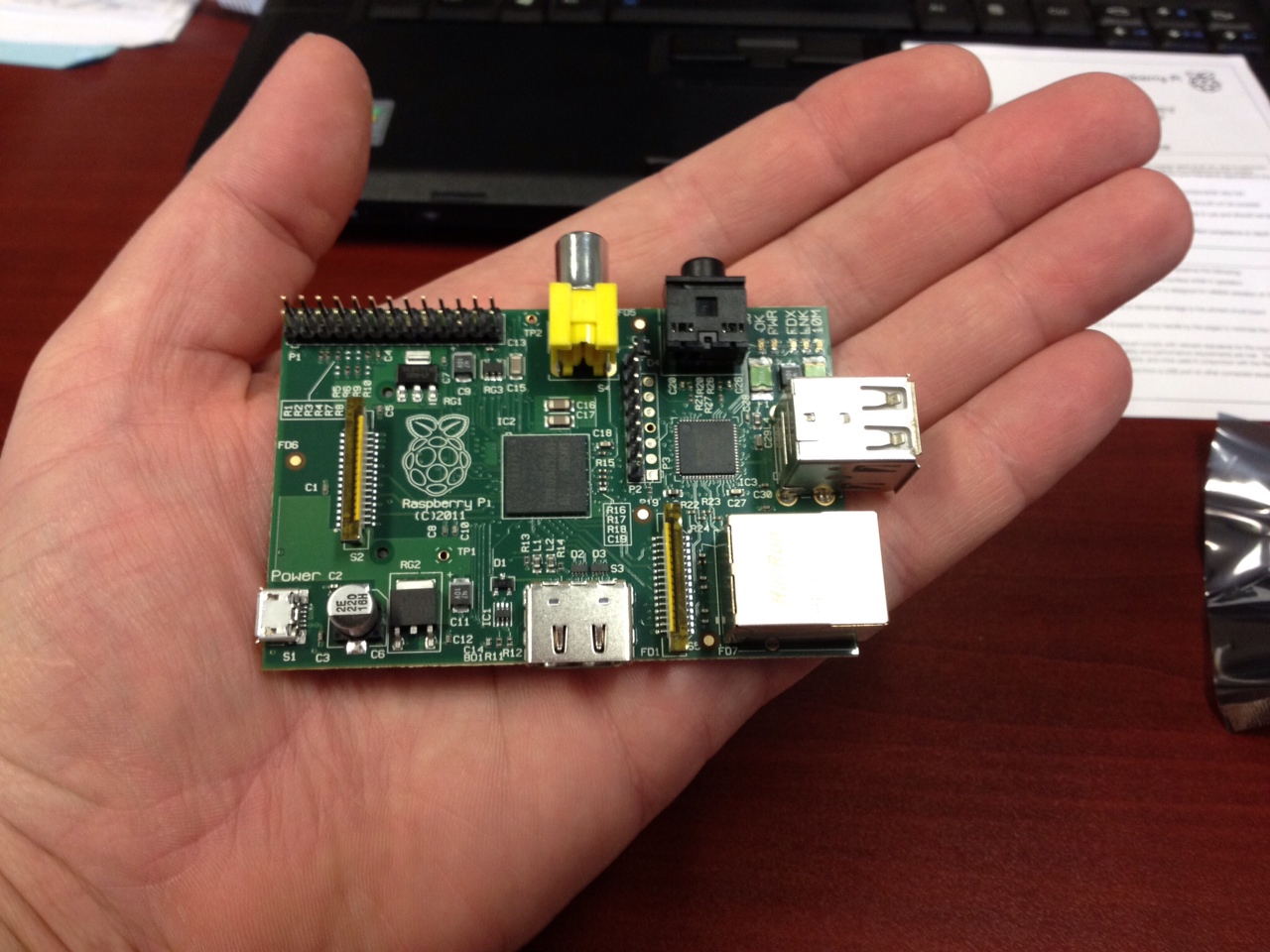

Microcontrollers: A Brief Introduction, History and Guide to the Tiny Computers Inside Modern Technology
Preamble
Microcontrollers are among the most important yet least visible technologies in the modern world. They are hidden inside household appliances, motor vehicles, medical equipment, toys, industrial machinery, security systems and thousands of other products.
Unlike desktop computers and smartphones, microcontrollers are rarely noticed by the people who use them. They normally perform a specific task quietly and repeatedly, often for many years, without requiring a keyboard, screen or conventional operating system.
A microcontroller may monitor the temperature inside a refrigerator, control the fuel injection system in a vehicle, operate a washing machine, regulate an electric motor or collect information from an environmental sensor.
Although individual microcontrollers can cost very little, their combined influence on modern technology is enormous. They allow ordinary products to sense their surroundings, process information and respond intelligently.
This article provides an accessible introduction to microcontrollers, examines their history and explains the people, companies, countries and materials that contributed to their development.
What Is a Microcontroller?
A microcontroller is a compact computer contained within a single integrated circuit, commonly called a chip.
It usually combines several important components:
- A central processing unit, or CPU
- Program memory
- Working memory
- Digital input and output connections
- Timers and counters
- Communication interfaces
- Analogue measurement circuitry
- Clock and power-management systems
A traditional computer may use separate chips for its processor, memory and peripheral controllers. A microcontroller combines most or all of these functions into one package.
This makes it smaller, cheaper and more energy-efficient than a general-purpose computer.
Microcontrollers are designed primarily for embedded systems. An embedded system is a computer built into a larger device to perform one or more dedicated functions.
A microwave oven, for example, may contain a microcontroller that reads the control panel, measures cooking time, monitors safety switches and controls the display, light, fan and magnetron.
The person using the microwave does not interact with the microcontroller directly, but the appliance could not operate correctly without it.
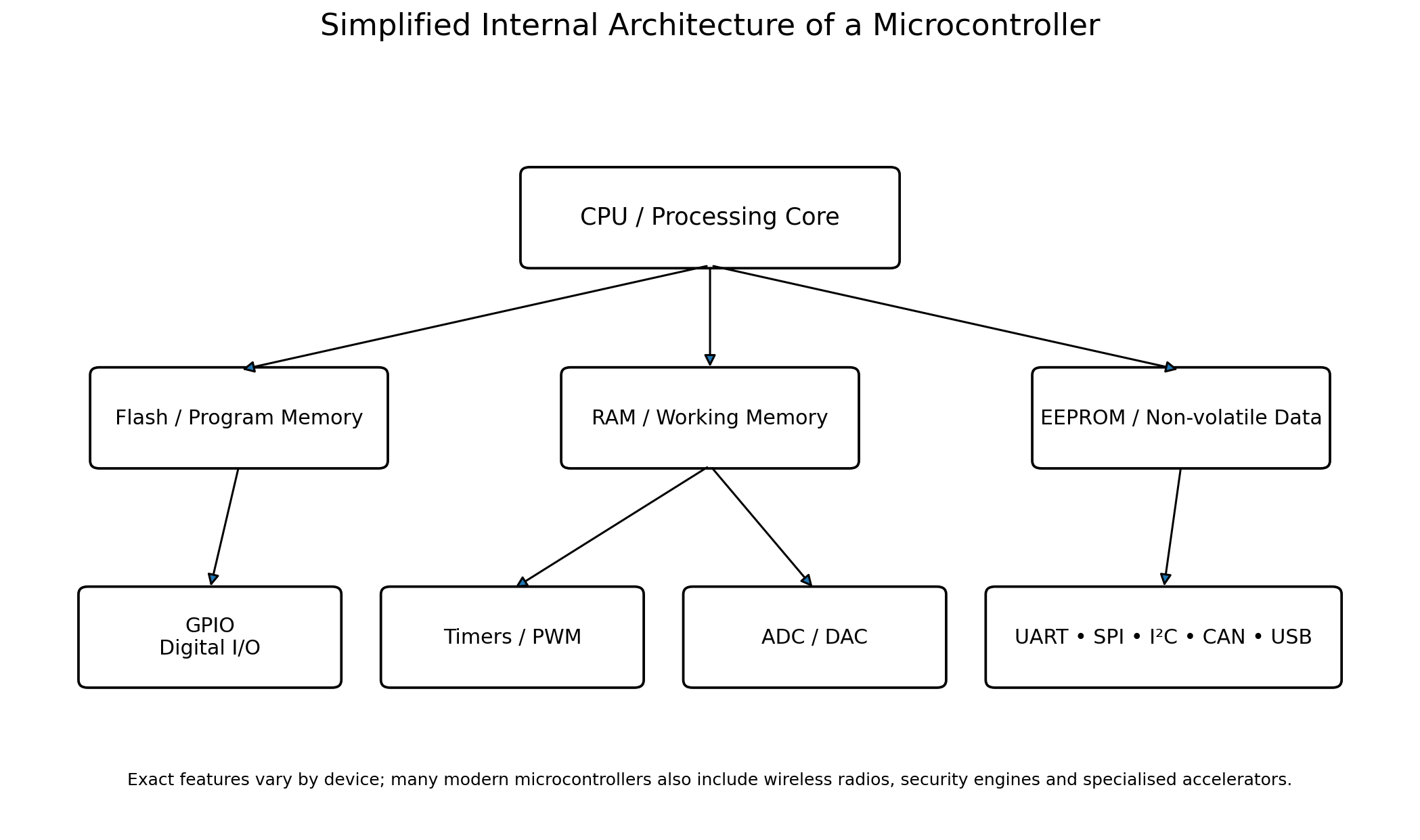
How a Microcontroller Works
Most microcontroller applications follow a simple pattern:
- Sense something in the physical world.
- Process the information according to a program.
- Control an output or communicate the result.
A temperature-control system provides a straightforward example.
A temperature sensor produces an electrical signal. The microcontroller reads that signal and converts it into a numerical value. It then compares the measured temperature with a target temperature.
When the room is too cold, the microcontroller activates the heating. When the target temperature is reached, it switches the heating off.
This basic sense–decide–act cycle is used in countless systems.

Microcontrollers and Microprocessors
The terms microcontroller and microprocessor are sometimes used interchangeably, but they do not mean exactly the same thing.
A microprocessor is primarily a CPU. It normally requires external memory, storage and supporting chips before it can operate as a complete computer.
A microcontroller usually includes its processor, memory and peripheral functions on the same chip.
Microprocessors are generally associated with systems requiring substantial computing power, including desktop computers, laptops and servers.
Microcontrollers are more commonly used where low cost, low power consumption, predictable operation and direct interaction with electronic hardware are important.
The distinction has become less clear as technology has advanced. Some modern microcontrollers are powerful enough to run sophisticated operating systems, while many microprocessors now contain functions that were once supplied by separate chips.
Nevertheless, a useful distinction remains:
A microprocessor is normally the centre of a general-purpose computer, while a microcontroller is normally the controller inside a dedicated product or machine.
The Electronic Foundations of the Microcontroller
Microcontrollers did not appear as a single isolated invention. They emerged from several earlier breakthroughs in physics, materials science, electronics and manufacturing.
The most important foundations included:
- Semiconductor materials
- The transistor
- The integrated circuit
- Planar semiconductor manufacturing
- Metal-oxide-semiconductor technology
- The microprocessor
- Programmable memory
Together, these developments made it possible to place increasingly complex electronic systems onto progressively smaller pieces of material.
Semiconductor Materials
The physical foundation of most microcontrollers is silicon.
Silicon is a chemical element commonly found in minerals and compounds such as silica. Silica is a major component of sand, although semiconductor-grade silicon cannot simply be produced by placing ordinary beach sand into a factory.
The material must undergo extensive purification before it can be used in electronic devices.
Extremely pure silicon is formed into large cylindrical crystals called ingots. These ingots are sliced into thin circular wafers. Electronic circuits are then created on the surface of each wafer through a series of highly controlled manufacturing processes.
Silicon became the dominant semiconductor material because it offered a favourable combination of availability, manufacturing practicality, electrical behaviour and cost.
Other important semiconductor materials include:
Germanium
Germanium was used in some early transistors and semiconductor devices. It remains useful in specialised applications, but silicon became the dominant material for mainstream integrated circuits.
Gallium arsenide
Gallium arsenide can operate at high frequencies and is used in radio-frequency, optical and specialist electronic applications.
Silicon carbide
Silicon carbide is increasingly important in high-voltage and high-temperature power electronics, including electric vehicles and energy systems.
Gallium nitride
Gallium nitride is used in high-efficiency power conversion, radio-frequency equipment and advanced lighting applications.
Although these materials are important to the wider semiconductor industry, the overwhelming majority of conventional microcontrollers are based primarily on silicon technology.
The Invention of the Transistor
Before the transistor, electronic equipment relied heavily on vacuum tubes.
Vacuum tubes could amplify signals and act as switches, but they were physically large, consumed considerable power, produced heat and had limited lifespans.
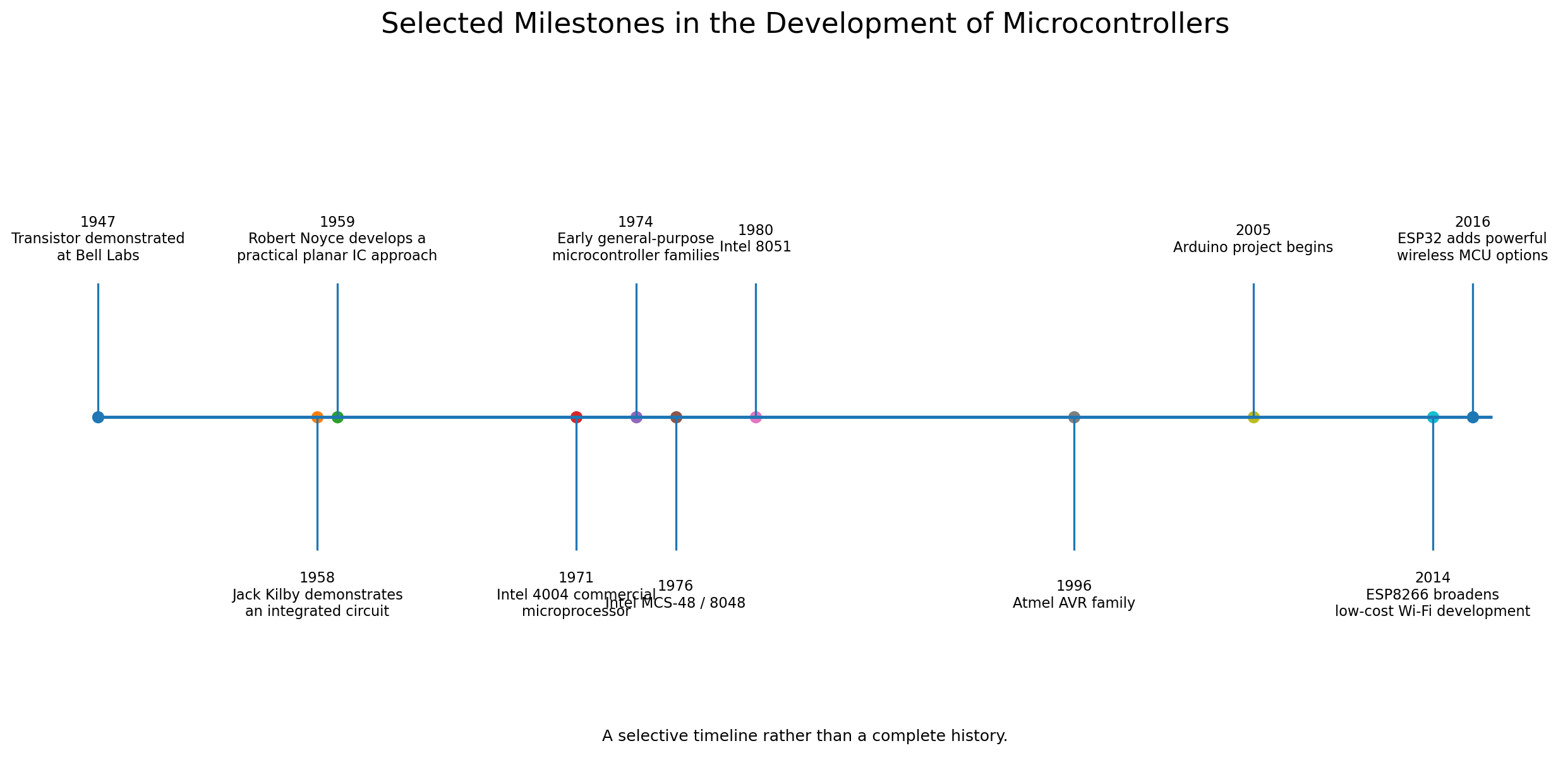
The transistor was demonstrated at Bell Laboratories in the United States in 1947. The work is closely associated with John Bardeen, Walter Brattain and William Shockley.
The transistor could perform many of the functions of a vacuum tube while being much smaller and more energy-efficient.
It became the basic switching element from which modern digital electronics would eventually be constructed.
A microcontroller contains transistors arranged into logic gates, memory cells, amplifiers, communication circuits and many other structures.
Modern devices may contain millions or even billions of transistor-like elements, depending on their complexity.
The Integrated Circuit
Early transistorised systems still required large numbers of separate components to be connected manually.
As circuits became more complicated, this approach created a serious manufacturing problem sometimes called the “tyranny of numbers”. The more components a system required, the greater the number of connections that could fail.
The integrated circuit solved much of this problem by placing multiple electronic components onto a single piece of semiconductor material.
In 1958, Jack Kilby of Texas Instruments demonstrated an early working integrated circuit.
Robert Noyce of Fairchild Semiconductor independently developed an influential integrated-circuit approach based on planar silicon manufacturing. Noyce’s method was particularly important because it was well suited to practical mass production and electrical interconnection.
Kilby and Noyce are therefore both widely associated with the invention and development of the integrated circuit.
The integrated circuit made it possible to manufacture electronic systems that were smaller, faster, more reliable and less expensive.
Without it, neither the microprocessor nor the microcontroller could have become practical mass-market technologies.
From Integrated Circuits to Microprocessors
During the 1960s, integrated circuits became increasingly complex.
Engineers learned how to place more transistors and more complete functions onto a single chip. Logic circuits, memory devices and calculator components gradually became more sophisticated.
A major breakthrough occurred when the main processing functions of a computer were combined into a small number of chips and eventually into a single processor chip.
The Intel 4004, introduced commercially in 1971, is widely regarded as the first commercially available general-purpose microprocessor on a single chip.
It was originally developed as part of a calculator system for the Japanese company Busicom.
Several people made important contributions to the project:
- Ted Hoff helped define the processor architecture.
- Stan Mazor contributed to the architecture and programming concepts.
- Federico Faggin led the detailed chip design and implementation.
- Masatoshi Shima, working with the Japanese calculator company, contributed substantially to the logic design and implementation.
The Intel 4004 was a 4-bit processor. By modern standards its capabilities were extremely limited, but it demonstrated that a programmable central processor could be placed on a single silicon chip.
This changed the direction of computing and electronics.
The Birth of the Microcontroller
A microprocessor alone was not a complete control system. It generally required external memory and peripheral chips.
Engineers soon began combining the processor, memory and input/output functions into more highly integrated devices.
During the early 1970s, several companies developed products that can be considered early microcontrollers or single-chip microcomputers.
Texas Instruments developed the TMS1000 family, which incorporated a processor, memory and input/output functions on one chip. These devices were used in calculators, toys, appliances and other embedded applications.
Intel introduced the MCS-48 family during the 1970s. Its best-known member, the 8048, was used in a wide variety of products, including keyboards, consumer equipment and control systems.
In 1980, Intel introduced the 8051 microcontroller family.
The 8051 became one of the most influential microcontroller architectures in history. Variants and compatible designs were produced by numerous manufacturers, and the architecture remained in use for decades.
The popularity of the 8051 demonstrated the value of a standard, flexible and relatively complete single-chip control system.
Expansion During the 1980s and 1990s
During the 1980s and 1990s, microcontrollers became standard components in consumer and industrial electronics.
Several important companies and product families emerged.
Motorola
Motorola developed numerous microprocessor and microcontroller families, including the 6800-derived families and the widely used 68HC series.
These devices appeared in vehicles, industrial control systems, consumer products and educational equipment.
Motorola’s semiconductor operations later became associated with companies including Freescale Semiconductor and, subsequently, NXP Semiconductors.
Microchip Technology
Microchip Technology became closely associated with the PIC family of microcontrollers.
PIC devices gained a strong following among engineers, students and hobbyists because they were available in many sizes and could be used in relatively simple embedded-control systems.
Atmel
Atmel produced several important microcontroller families, including the AVR architecture introduced during the 1990s.
AVR microcontrollers became especially significant because they later formed the basis of many early Arduino boards.
Atmel was subsequently acquired by Microchip Technology.
Texas Instruments
Texas Instruments continued to produce embedded processors, digital signal processors and microcontrollers.
Its MSP430 family became well known for low-power applications, particularly battery-operated measuring and sensing equipment.
STMicroelectronics
STMicroelectronics developed a wide range of microcontrollers and later became particularly prominent through its STM32 family, based on Arm processor cores.
STM32 devices are widely used in commercial, industrial, consumer and hobbyist applications.
Renesas and Japanese Manufacturers
Japanese companies played a major role in microcontroller development and manufacturing, particularly for automotive electronics, consumer products and industrial equipment.
Renesas Electronics, formed from semiconductor operations associated with companies including Hitachi, Mitsubishi Electric and NEC, became one of the world’s leading suppliers of embedded processors and microcontrollers.
The Importance of Programmable Memory
Early microcontrollers were often manufactured with permanently programmed memory.
This was suitable for high-volume products but inconvenient for experimentation and small production runs.
The development of erasable and electrically programmable memory made microcontrollers far more flexible.
EPROM devices could be erased using ultraviolet light and programmed again. EEPROM and flash memory later allowed electrical reprogramming without removing the chip from the circuit.
Flash memory was particularly important because it allowed software to be uploaded, tested, corrected and replaced relatively easily.
This supported faster development and helped make microcontrollers more accessible to students, independent developers and hobbyists.
The Arduino Revolution
Microcontrollers were already widespread by the beginning of the twenty-first century, but using them could still be difficult for newcomers.
Developers often needed specialist programming equipment, detailed datasheets, complex software tools and a strong understanding of electronic hardware.
Arduino helped change this situation.
The Arduino project began in Ivrea, Italy, in 2005. It was developed as an affordable platform for students working on interactive design and electronic projects.
People closely associated with Arduino’s development include:
- Massimo Banzi
- David Cuartielles
- David Mellis
- Tom Igoe
- Gianluca Martino
The project also drew heavily on earlier open-source educational work, particularly Hernando Barragán’s Wiring platform and the Processing programming environment.
Arduino combined several existing ideas into an unusually accessible package:
- A low-cost development board
- A USB connection
- A simplified programming environment
- Open-source hardware designs
- Reusable software libraries
- Extensive example projects
- Strong community support
The early Arduino boards used Atmel AVR microcontrollers.
The Arduino Uno, based for many years on the ATmega328P, became the platform’s most recognisable board.
Arduino did not invent the microcontroller, nor was it the first development board. Its achievement was to make microcontroller development approachable to a much wider audience.
Artists, schoolchildren, designers, inventors and home users could begin creating working electronic projects without first becoming professional electronics engineers.
Arduino Variants
The Arduino ecosystem expanded to include boards aimed at different requirements.
Arduino Uno
The Uno became the standard beginner board and is widely used in education, experimentation and introductory electronics.
Arduino Nano
The Nano provides Arduino functionality in a smaller format suitable for compact projects.
Arduino Mega
The Mega offers more memory and substantially more input and output connections, making it useful for larger projects such as robotics, automation equipment and some early 3D-printer controllers.
Arduino Leonardo
The Leonardo can communicate directly as a USB device, allowing it to imitate equipment such as a keyboard or mouse.
Arduino Due
The Due introduced a more powerful 32-bit Arm-based processor to the official Arduino family.
Arduino MKR Boards
The MKR range was designed largely for connected and Internet of Things applications. Different models support technologies including Wi-Fi, cellular communication and long-range radio.
Arduino Nano 33 and Later Nano Boards
Later Nano models introduced faster 32-bit processors, wireless communication, sensors and machine-learning capabilities while retaining a compact form.
Arduino Portenta
The Portenta range is aimed at professional, industrial and advanced computing applications. These boards offer considerably more processing power than traditional beginner-level Arduino products.
The Wider Maker Microcontroller Ecosystem
Arduino’s success encouraged a much larger ecosystem of accessible development boards.
ESP8266
The ESP8266, developed by Espressif Systems in China, made low-cost Wi-Fi connectivity available to hobbyists and product developers.
It became extremely popular for home automation and Internet of Things projects.
ESP32
The ESP32 expanded on this idea with greater processing power, Wi-Fi, Bluetooth and a wide range of built-in peripheral functions.
ESP32 devices are now used in sensors, displays, smart-home equipment, wearable devices and commercial prototypes.
Raspberry Pi Pico and RP2040
The Raspberry Pi Pico introduced the RP2040 microcontroller designed by Raspberry Pi.
It offered a low-cost, modern microcontroller platform backed by the educational reputation and community surrounding Raspberry Pi.
Arm Cortex-M Devices
Arm does not usually manufacture the finished microcontrollers itself. Instead, it licenses processor designs to semiconductor companies.
Arm Cortex-M processor cores are used in microcontrollers produced by STMicroelectronics, NXP, Nordic Semiconductor, Infineon, Texas Instruments, Microchip and many others.
This licensing model helped create a broad ecosystem of compatible development tools and processor architectures.
Common Microcontroller Use Cases
Microcontrollers are used wherever a product needs to measure, control, communicate or respond.
Household Appliances
Microcontrollers manage the operation of:
- Washing machines
- Dishwashers
- Refrigerators
- Microwave ovens
- Coffee machines
- Vacuum cleaners
- Central-heating controls
- Air-conditioning systems
They monitor buttons and sensors, control timing and operate motors, heaters, pumps and displays.
Motor Vehicles
Modern vehicles may contain many microcontrollers.
They are used in:
- Engine management
- Battery control
- Airbags
- Anti-lock braking
- Electric windows
- Lighting
- Climate control
- Parking sensors
- Infotainment
- Driver-assistance systems
Automotive microcontrollers must operate reliably under demanding conditions involving heat, vibration and electrical interference.
Industrial Automation
Factories use microcontrollers in:
- Motor-control systems
- Sensors
- Production machinery
- Robotics
- Measurement instruments
- Data loggers
- Safety equipment
- Maintenance-monitoring systems
Some industrial systems use dedicated programmable logic controllers, but microcontrollers are frequently found inside individual sensors, drives and machine components.
Medical Equipment
Microcontrollers can be found in:
- Blood-pressure monitors
- Thermometers
- Portable diagnostic devices
- Infusion pumps
- Hearing aids
- Patient-monitoring systems
- Laboratory equipment
Medical applications generally require careful design, testing and regulatory approval.
Consumer Electronics
Remote controls, cameras, toys, audio equipment, printers, keyboards and smart accessories frequently contain one or more microcontrollers.
Home Automation
Home users employ Arduino, ESP32 and similar boards to create:
- Smart lighting
- Environmental monitors
- Alarm systems
- Automated blinds
- Heating controls
- Energy monitors
- Garden-watering systems
- Door and gate controllers
Education
Microcontrollers allow students to see an immediate physical result from a program.
A few lines of code can flash a light, operate a motor, measure temperature or move a robot.
This makes microcontrollers valuable for teaching:
- Programming
- Electronics
- Design
- Engineering
- Mathematics
- Robotics
- Problem-solving
- Physical computing
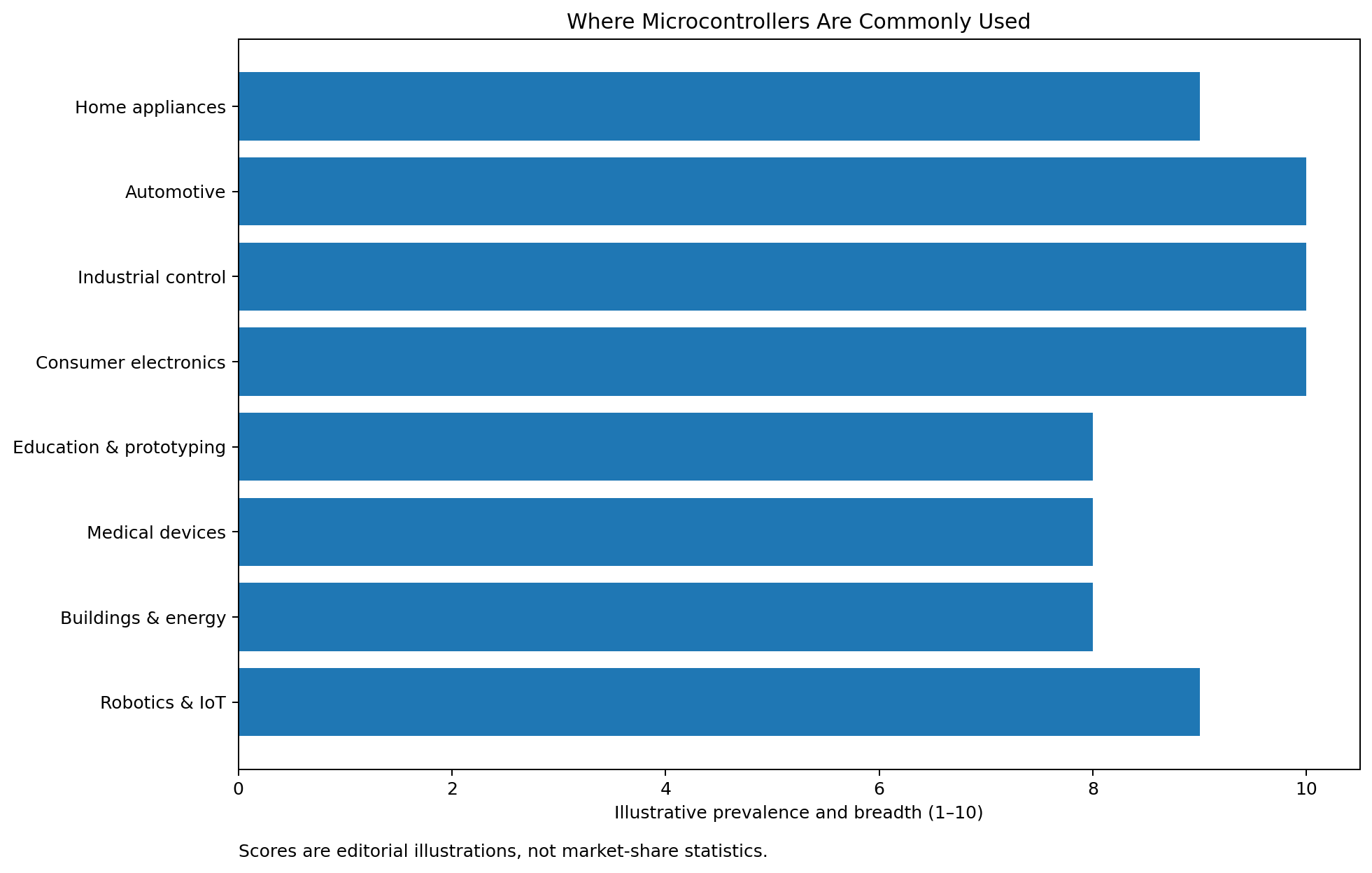
The chart is an editorial illustration of the breadth of application rather than measured market-share data.
Microcontrollers in Commercial Development
Development boards are sometimes dismissed as hobbyist products, but they play an important role in commercial engineering.
A company may use an Arduino, STM32, ESP32 or Raspberry Pi Pico board to build an early prototype.
This allows engineers to:
- Test sensors and components
- Demonstrate a product idea
- Develop software before custom hardware exists
- Evaluate communication systems
- Gather trial data
- Identify technical risks
Once the concept has been proven, the development board may be replaced by a custom circuit containing only the components needed for the final product.
This can reduce cost, size and power consumption while improving reliability.
Some products continue to use complete development-board modules, particularly where production volumes are modest and rapid development is more important than minimising every component cost.
Typical Parts of a Microcontroller Project
A complete project usually contains more than the microcontroller itself.
It may include:
- Sensors or switches
- A power supply
- Output drivers
- Motors, relays or lights
- A display
- Wireless communication
- Protective circuitry
- Connectors and cables
- A printed circuit board
- Mechanical housing
- Embedded software

The proportions are conceptual and will vary considerably between projects.
Key People
The development of microcontrollers depended on the work of thousands of scientists, engineers and manufacturing specialists. The following people represent some of the most widely recognised contributors to the underlying technologies.
| Person | Principal contribution |
|---|---|
| John Bardeen | Co-inventor of the transistor |
| Walter Brattain | Co-inventor of the transistor |
| William Shockley | Transistor pioneer and semiconductor theorist |
| Jack Kilby | Demonstrated an early integrated circuit at Texas Instruments |
| Robert Noyce | Developed an influential planar silicon integrated-circuit approach |
| Jean Hoerni | Developed the planar semiconductor process |
| Gordon Moore | Semiconductor pioneer, Intel co-founder and originator of Moore’s Law |
| Ted Hoff | Helped define the Intel 4004 architecture |
| Stan Mazor | Contributed to early Intel microprocessor architecture and software |
| Federico Faggin | Led the detailed design and implementation of the Intel 4004 |
| Masatoshi Shima | Major contributor to the Intel 4004 logic design |
| Massimo Banzi | Arduino co-founder and prominent advocate of accessible electronics |
| David Cuartielles | Arduino co-founder and educator |
| David Mellis | Developed important early Arduino software |
| Tom Igoe | Helped establish Arduino in education and physical computing |
| Hernando Barragán | Created Wiring, an important predecessor to Arduino |
This is not a complete list. Microcontrollers were produced through collaborative developments involving physics, chemistry, computer science, manufacturing, electrical engineering and software design.
Key Companies and Organisations
Bell Laboratories
Bell Labs was central to the development of the transistor and numerous other advances in electronics and communications.
Texas Instruments
Texas Instruments contributed to the integrated circuit and produced some of the earliest single-chip microcontroller families.
Fairchild Semiconductor
Fairchild played a major role in planar semiconductor manufacturing and the early commercial integrated-circuit industry.
Intel
Intel developed influential early microprocessors and microcontrollers, including the 4004, MCS-48 and 8051.
Motorola
Motorola produced important processors and microcontrollers used in vehicles, industrial equipment and consumer products.
Microchip Technology
Microchip became a major supplier through the PIC, AVR and other embedded product families.
Atmel
Atmel created the AVR architecture used by many early Arduino boards. Atmel later became part of Microchip Technology.
STMicroelectronics
STMicroelectronics produces the STM32 family and many other semiconductor components used in embedded systems.
NXP Semiconductors
NXP produces microcontrollers and processors for automotive, industrial, communications and consumer applications.
Renesas Electronics
Renesas is a major Japanese supplier of automotive, industrial and general embedded processors.
Arm
Arm developed processor architectures that are licensed to many microcontroller manufacturers.
Espressif Systems
Espressif helped make affordable Wi-Fi and Bluetooth microcontrollers widely available through the ESP8266 and ESP32 families.
Arduino
Arduino made microcontroller development substantially more accessible to students, makers, artists and non-specialist developers.
Raspberry Pi
Raspberry Pi extended its educational hardware ecosystem into microcontrollers with the RP2040 and Raspberry Pi Pico.
Countries and Regions That Shaped the Industry
Microcontroller history is international.
United States
The United States played a central role in the invention of the transistor, integrated circuit, microprocessor and several early microcontroller families.
Important centres included Silicon Valley, Texas and research institutions such as Bell Labs.
Japan
Japanese electronics and calculator companies helped create demand for early processors. Japan later became a major producer of semiconductor equipment, materials, consumer electronics, vehicles and embedded systems.
Italy
Italy is particularly important to the popular history of microcontrollers because Arduino began in Ivrea.
United Kingdom
The United Kingdom has a long history in computing and semiconductor design. Cambridge-based Arm became one of the most influential processor-architecture companies in the world.
The Raspberry Pi organisation also emerged from the United Kingdom and has played an important role in computer and electronics education.
Germany and France
Germany and France have contributed substantially to European semiconductor research, automotive electronics, industrial automation and manufacturing.
STMicroelectronics has important French and Italian roots, while companies such as Infineon are closely connected to Germany’s industrial and automotive sectors.
Netherlands
The Netherlands has been influential through Philips, NXP Semiconductors and ASML.
ASML manufactures advanced photolithography equipment that is essential to the production of many modern semiconductor devices.
Taiwan
Taiwan became one of the world’s most important semiconductor-manufacturing centres.
Taiwan Semiconductor Manufacturing Company, better known as TSMC, produces chips designed by companies around the world.
South Korea
South Korea became a major semiconductor manufacturing country, particularly through companies such as Samsung and SK Hynix.
China
China has become important in semiconductor assembly, electronics manufacturing, microcontroller design and the production of affordable development boards and connected devices.
How a Microcontroller Is Manufactured
Microcontroller production is extraordinarily complex.
A simplified process includes the following stages:
- Silicon purification: Raw silicon is refined to extremely high purity.
- Crystal growth: A large single-crystal silicon ingot is produced.
- Wafer slicing: The ingot is cut into thin circular wafers.
- Surface preparation: The wafers are polished to an extremely smooth finish.
- Layer formation: Insulating, conducting and semiconductor layers are created.
- Photolithography: Patterns are projected onto light-sensitive material on the wafer.
- Etching: Selected material is removed.
- Doping: Small quantities of other elements are introduced to change the silicon’s electrical behaviour.
- Deposition and interconnection: Conductive layers connect the microscopic components.
- Testing: Individual circuits are electrically tested.
- Dicing: The wafer is cut into separate chips.
- Packaging: Each chip is mounted in a protective package.
- Final testing: The packaged devices are tested and classified.
A single finished microcontroller may depend on materials, software, machinery and specialist knowledge supplied by companies in many different countries.
Advantages of Microcontrollers
Microcontrollers offer several important advantages:
- Low cost
- Small physical size
- Low energy consumption
- Fast startup
- Direct control of electronic hardware
- Reliable repetitive operation
- Long product life
- Suitability for mass production
- Availability in many performance levels
They can often run for months or years from a battery, particularly when designed to spend much of their time in a low-power sleep mode.
Limitations and Challenges
Microcontrollers also have limitations.
They generally provide less memory and processing power than personal computers or high-end application processors.
Developers may need to work within strict limits involving:
- Memory
- Program size
- Energy consumption
- Processing time
- Storage
- Component cost
- Heat
- Electrical interference
Security is an increasingly important concern.
A connected microcontroller may control a lock, collect personal information or communicate with industrial equipment. Poorly designed software can therefore create significant risks.
Modern devices increasingly include:
- Secure boot systems
- Encryption hardware
- Protected memory
- Device identity features
- Firmware-signing systems
- Tamper resistance
Long-term software maintenance is becoming as important as the original electronic design.
The Future of Microcontrollers
Microcontrollers continue to become more capable while remaining affordable and energy-efficient.
Important trends include:
Edge Artificial Intelligence
Some microcontrollers can now run small machine-learning models locally.
This allows devices to recognise sounds, gestures, movement patterns or sensor conditions without sending all information to a remote server.
Greater Wireless Integration
Wi-Fi, Bluetooth, cellular communication, Thread, Zigbee and long-range radio are increasingly integrated into microcontroller products.
Ultra-Low-Power Operation
Improved power management allows remote sensors and wearable devices to operate for long periods from small batteries or harvested environmental energy.
Improved Security
Security features are becoming essential as microcontrollers are connected to homes, vehicles, factories and public infrastructure.
More Accessible Development
Browser-based programming, visual tools, reusable libraries and inexpensive development boards are making embedded technology accessible to an even wider audience.
Open Source Hardware and Software
Open-source communities continue to share board designs, operating systems, software libraries and complete projects.
This accelerates education and experimentation, although commercial and safety-critical products still require careful engineering and testing.
Conclusion
The microcontroller is one of the defining technologies of modern electronics.
Its development depended on advances in semiconductor materials, transistor design, integrated circuits, manufacturing, computer architecture and programmable memory.
The work crossed national and institutional boundaries. American research laboratories and semiconductor companies contributed many early breakthroughs. Japanese companies helped drive demand and commercial application. European organisations shaped industrial electronics, processor design and educational platforms. Taiwan, South Korea and other Asian manufacturing centres became vital to global semiconductor production.
From early single-chip computers such as the TMS1000 and Intel MCS-48 to the 8051, PIC, AVR, STM32, ESP32 and RP2040, microcontrollers have steadily become more powerful, affordable and accessible.
Arduino represents an especially important chapter in this history. It did not invent the microcontroller, but it helped open microcontroller technology to millions of people who might otherwise never have encountered embedded electronics.
Today, microcontrollers are used by multinational manufacturers, small businesses, universities, schools, artists, inventors and home hobbyists.
They quietly connect software to the physical world. They read sensors, make decisions, control machines and communicate information.
Most people may never see the microcontrollers they depend on, but these tiny computers have become essential components of everyday life.
Thank you for visiting my site, Anthony Matabaro.
